It's odd how in 3D videogames the best way to examine an object closely is to look at it in your peripheral vision, which enlarges it.
I have yet to see a game that protects secrets from datamining by encrypting game assets with a key that is the solution to an in-game puzzle.
For instance, you enter a password into a locked door and the password is used to decrypt 3D objects, text, scripts, etc. that lie behind the door.
The main problem is that the password needs to be fairly long/complex to resist brute force, so it might be a bit annoying to enter in-game.
#274 - The Loophole dev actually said on a podcast that early designs for his game were 3D and not bound to a grid.
I'm also not sure the idea would work as a game, I'm just interested in trying to code line-of-sight, maybe it could be a stealth game or something with time travel.
Well, it will have to wait until I finish my current project.
It's really easy to overestimate how visible text is in 3D.
Your intuition of how visible a sign would be in the real world is totally off, if it's displayed on a 1080p screen.
The fastest way to do noise is probably to have a low-ish resolution noise texture and fBm it in the shader, right?
I'll try this next time.
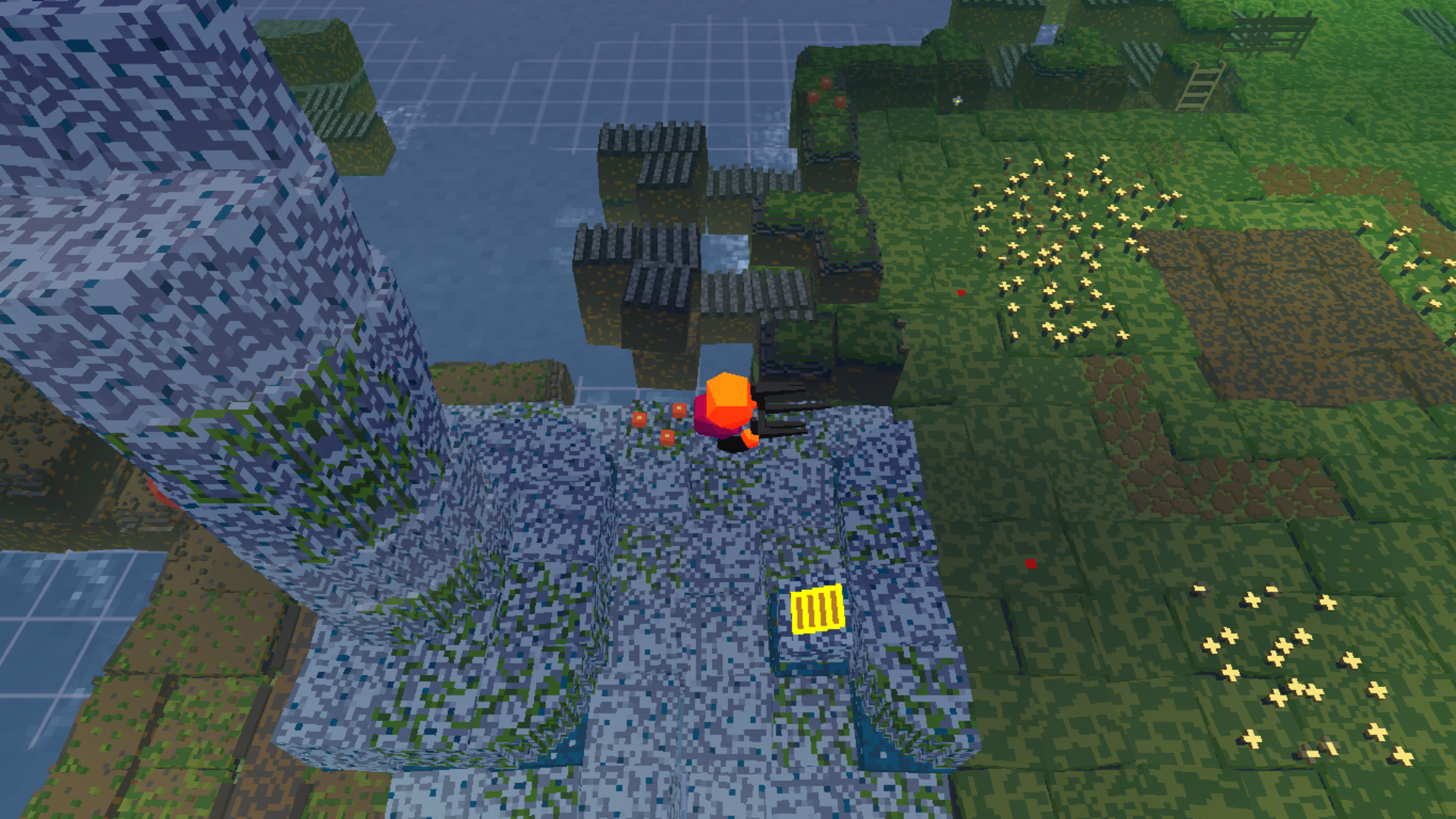
A wise man once said that you should apply a small vertex jitter to voxel grids.
I won't be doing that in my game, but it's surprising how well it works.
You'd think that it would be irritating or distracting for a discrete grid to be slightly uneven while you're focusing on a puzzle, but it's not at all and might even have the opposite effect.
I'm not entirely sure why but I have a few theories:
1) The jitter scale gives you another way to judge depth, which can be hard sometimes with blocky voxels.
2) It disrupts some subtle optical illusion which makes parallel lines confusing to look at.
3) It makes it harder to miscount grid lines because they now look slightly different from one another.
In #224 I noticed that all sudoku variants are just different constraints on the same underlying system and they can all be solved with linear programming.
Watching a talk about puzzle game design has gotten me wondering if many puzzle games are exploring some known area of mathematics with a lot of window dressing.
Probably something like group theory or graph theory most of the time.
Are those the only fields which translate well to puzzle games?
Rather than the standard process of exploration and prototyping, I wonder if one could steal puzzle concepts directly from mathematics.
A topic which mathematicians spent lifetimes examining must have a lot of surprise to offer the layman.
I think it wouldn't be hard to teach advanced concepts to players that they wouldn't be interested in learning otherwise, and fun too if they were allowed to enjoy discovery rather than being given theorems up front.
Also it would be a funny twist at the end to reveal explicitly to the player how each puzzle maps onto mathematical notation.