.:about:.
kurt weiske's retro tech enthusiast, photgrapher, and systems guy. blogging like it's 1999. static blog generation, talking tech...
.:subscribe:.
subscribe to a syndicated RSS feed.
.:links:.
realitycheckBBS
kataan.org
other blog.
.:contact:.
mastodon
tilde.club


Writing again
I've been on a writing binge, scheduling 1 hour blocks of time to write. Not
edit, but to sit down with a spiral notebook and a Bic pen and write. No
going back, no strikethroughs, just running with an idea and seeing where it
takes me.
I realized my other attempts at writing have been heavily narrative - then again, they were nanowrimo efforts in 2014-2016. Trying to include emotions into the narrative makes for much easier flow and makes for better fiction, from what I've learned in this new experiment.
I like writing on paper with a pen, when I use a computer it's too tempting to edit as I go and break the creative flow. Or, to change the formatting and structure as I go. Better to let the words flow and edit later.
With my penchant for technology, gadgetry and toys, it's nice to eliminate the distractions and create with the lowest common denominator, a 45 cent notebook and 20 cent pen.
posted Sun, 20 Jul 2025
permanent link
"Return to Industry"
I've read articles chronicling Microsoft's latest round of layoffs. The
headline reads "Microsoft to axe "thousands" of its sales staff".
Microsoft is continuing to "focus on building high-performing teams and increasing our agility by reducing layers with fewer managers"
I suppose that's better when they reported that hundreds were "returned to industry", as reported by Microsoft's Ministry of good.speak.
posted Thu, 19 Jun 2025
permanent link
No EV
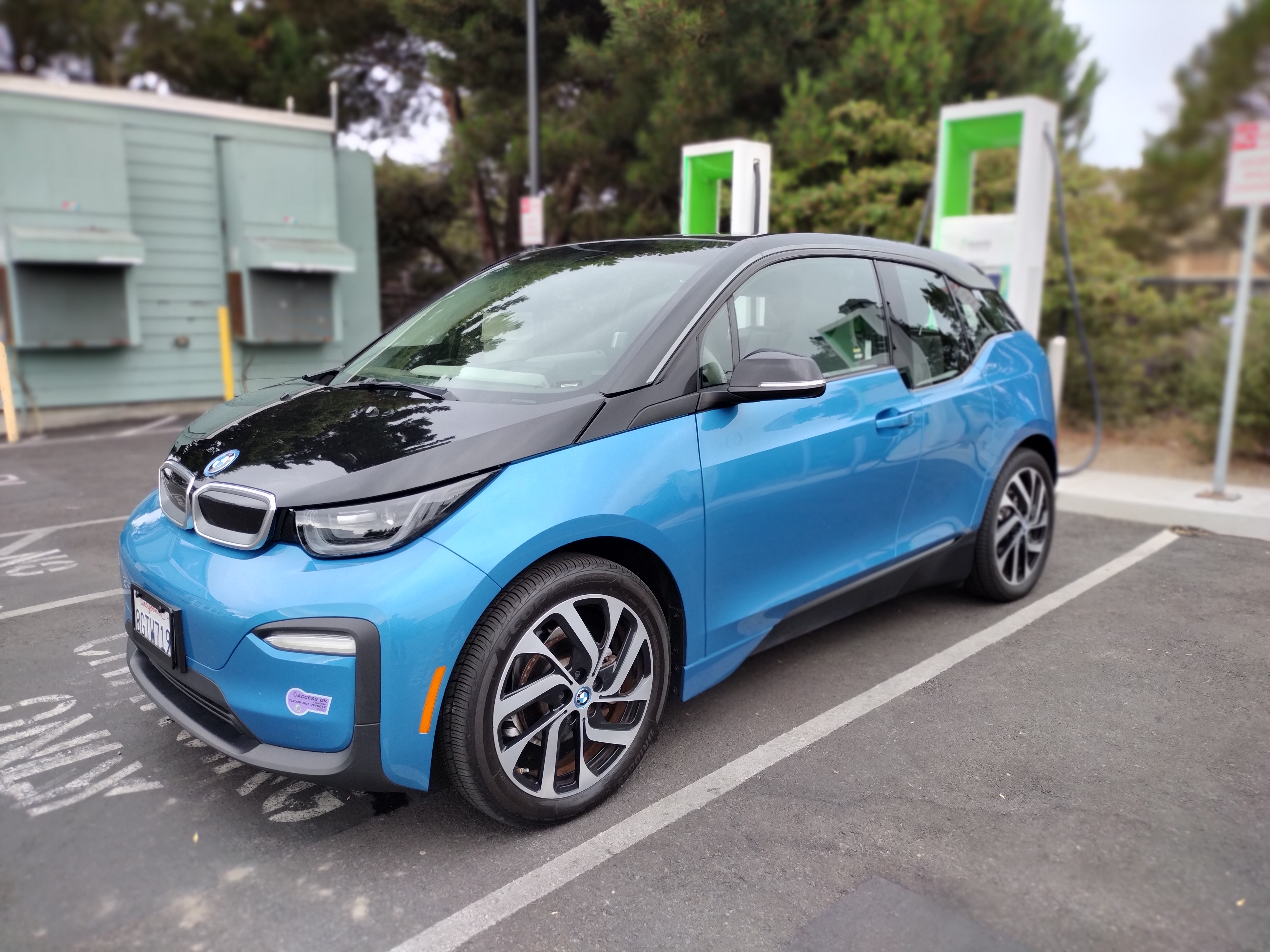 I tried, I gave
up. I
bought a BMW I3
in 2023, while I was working from home. I installed a 20 amp 208 circuit in
my carport, so I could charge my car at home, and all was well.
I tried, I gave
up. I
bought a BMW I3
in 2023, while I was working from home. I installed a 20 amp 208 circuit in
my carport, so I could charge my car at home, and all was well.
I started commuting a couple of days a week, a long commute - 75 miles each way. That was just enough for me to need to charge to get home. At first, I tried public chargers - roughly half of the chargers I tried failed to start charging, were broken, or in one case, the charger snapped off one of the plugs at the end of the car port, which is about a $3000 part!
I did love the car, it was efficient, quirky, well engineered. Surprisingly roomy for 4 people, albeit with front-opening rear doors.
I got sick of range anxiety, worrying about not having a spare tire, and wanting something with more room and bought a hybrid gas vehicle. Now I don't have to obsess over range, my electric bill will go down, and so far my best gas mileage was 52 MPG in freeway driving.
posted Sat, 31 May 2025
permanent link
Dead Flex
My Fitbit Flex 2 died after 10 years of use. Looking at the options out
there, I miss old tech like that.
The interface is 5 LEDs and it notified through a series of 5 colored LEDs and vibrations. Subtle, discrete, and it didn't demand your attention unless it needed it.
I don't need a touch-screen wrist-sized tablet, I want an adjunct that enhances my phone.
posted Fri, 21 Mar 2025
permanent link
Kindle Downloads
I read that Amazon is removing the ability to download books to your PC -
after 2/26/2025 you'll only be able to download to your Kindle over wifi.
I spent last night sorting through 800+ kindle books on the web page and downloaded most of them to my computer, then imported them into Calibre - my ebook manager.
I'll probably look for non-DRM ebooks moving forward, there are some other ebooks in the space now. While I'm using the Kindle app on my iPhone and a physical Kindle, it might be nice to look at a third-party reader. I've seen a couple of F/OSS Android e-book readers that look interesting.
posted Fri, 21 Feb 2025
permanent link
Global Switch Day
It's global switch day, a day to consider switching from siloed, private,
for-profit networks to open networks.
I'm already on Mastodon through tilde.zone, have a lemmy account through sdf, started playing with pixelfed, hadn't heard of friendica. I've got some time and and empty house on a rainy day, think I'll start playing with federated, open networks.
To be quite frank, I need to stop doom-scrolling Twitter for my mental health.
posted Sat, 01 Feb 2025
permanent link
enn eff ess
Woops!
I've created the last several VMs in my proxmox cluster on an NFS share
instead of locally.
Surprisingly, nothing broke.
posted Tue, 14 Jan 2025
permanent link
Not-so-dead NAS
I wrote earlier
about my old Synology NAS dying. Turns out, after taking the drives out and
letting it sit, I plugged a VGA monitor into it and I'm getting a GRUB
prompt. It's not mounting, the drives are in my new chassis.
I'm glad I bought the new chassis, the old one was over 10 years old and is going EOL next year. I only use it for file storage and don't expose it to the internet, so the lack of updates is less concerning than it could be. Still...
I could throw some drives in it, use it to back up my "production" (ha!) Synology unit and store it somewhere else for offsite backup.
posted Wed, 13 Nov 2024
permanent link
Am I crazy to think about self-hosting mail again?
Back in 2000-2004 I ran Courier IMAP, Sendmail, fetchmail and procmail
successfully. I had a couple of outages that compelled me to move my mail
services to a third-party and later to webmail.
I've never been a fan of my mail sitting in the cloud, but the benefits outweighed the advantages. Now, I've been concerned about leaving semi-sensitive data out there.
I have a homelab and could spin up a docker or LXC container easily, so I could certainly run another mail server for my other domains. Mailcow looks good, I've seen other all-in-one mail solutions as well.
My Synology NAS even has a pretty decent mail/collaboration app.
I'd like to end up with my email sitting behind my firewall, webmail available through my reverse proxy, and the only data sitting in the cloud being backups in encrypted blobs.
Before then, I'll need to upgrade my internet. Backing up 2TB of data over my 600/20 cable connection would be painfully slow and cost around $100 in overages.
Comcast blocks most SMTP traffic (and I think AT&T still does, too) so I'll need a solution to act as mail exchanger for 2-3 domains and forward them to me on an alternate port.
In the meantime, I could just download my mail from Google via IMAP and delete it from the server as I go.
posted Wed, 13 Nov 2024
permanent link
Dead NAS, dead NAS...
My Synology NAS finally died. It was a DS1010+, probably ran for years in
someone else server room. I bought it used 3 years ago, hacked it to let
the OS think it was a DS1511+.
I ran DSM 6.2 for the better part of two years, then after a power outage the chassis didn't come back.
One nice thing about Synology is their migration process. I bought a new chassis, installed the old drives into the new chassis, ran the system installer, and it recognized the old drives. After an OS upgrade and about 10 minutes, the drives, the pools, and most of the settings carried over.
Not too shabby.
posted Sun, 29 Sep 2024
permanent link