I rather enjoyed writing the review of UFO: Enemy Unknown I did last month, so I thought I'd write about another, much more recent game I've played and can't stop thinking about - Zero Parades for Dead Spies. This is an RPG (of sorts), created by the game studio ZAUM, over in Estonia. To say this game is laden with baggage is perhaps an understatement. ZAUM made their name with the outstanding Disco Elysium - my favourite CRPG of the last decade, maybe ever. Shortly after it's release, the studio found itself embroiled in a messy lawsuit with itself. The fanbase were up in arms, people were fired and eventually, the whole studio broke up. The situation is messy to say the least. People make games took a heroic stab at trying to make sense of it all; their youtube video is worth a watch. One day, I'd like to write about Disco Elysium, but for today, I'd like to focus on Zero Parades.
This is the problem of course - I'm only a paragraph into this review, and I'm already talking about the fallout from the ZAUM trouble, and the studio's previous Game. Pretty much every review I've read talks about Zero Parades in terms of its predecessor. "Is Zero Parades the spiritual successor to Disco Elysium?". "Have the new ZAUM studio managed their difficult second album?", "Are fans boycotting Zero Parades after what happened at ZAUM?" - these kinds of statements are all over the place. So I'm going to save all that to the end; I'm certainly not immune to comparisons with ZAUM's magnum opus. But lets at least try to look at Zero Parades on its own terms.
Info: I shall try not to include any specific spoilers for the game, but I'll use highlights like this to give you advance warning.
In Zero Parades you take on the role of Hershel Wilk - codename CASCADE - a spy for The Operant Bureau (known as the Opera), the intelligence agency of the communist superbloc. In this fictional world, two other powers are at play - the Illuminated Empire of La Luz and L'Empire Sans Terretoire (EMTERR) or The Bank. Herschel finds herself back in the city of Portofiro, 5 years after her entire network was blown wide open by The Weeping Eye - La Luz's spy agency. For 5 years you've been kept on ice, doing all the boring paperwork jobs the Opera needs done. But now, you are back in the field. The trailers paint a picture of a spy thriller, with a 90s style aesthetic. The tagline? Zero out the Grand Lich of Technofascism! Sounds pretty good to me, although when I hear the word 'technofascist' I can't help but hear Lister from Red-Dwarf saying "cryptofascist" in his amazing scouse accent!
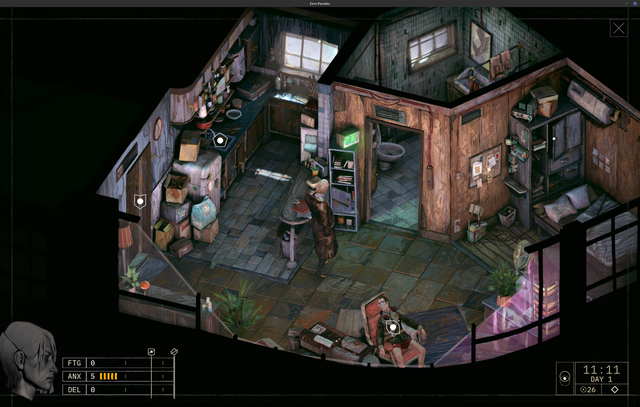
You view the world from an isometric1 perspective, guiding Herschel around a beautifully painted and realized city. It's immediately obvious that the designers and artists of this game wanted to set a particular tone - every scene has that hand-made quality to it, which I admire.
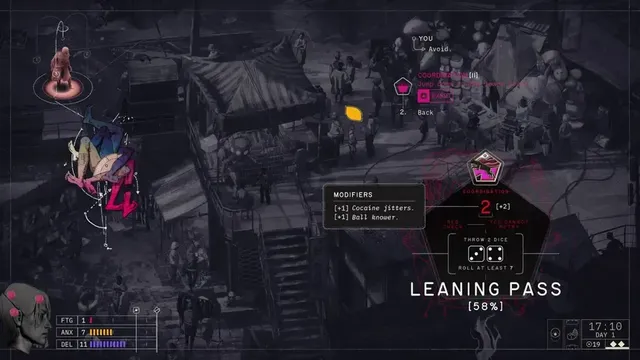
The gameplay is largely dialogue driven. Text appears on the right-hand side of the screen, wonderfully voice acted. During dialogue - or when clicking on certain items in the world - you'll be presented with a skill check. Roll 2 dice and add your skill, plus any other modifiers and meet or beat a target number.
There are 15 skills in the game, divided into three categories. Roughly, these equate to bodily action, psychology and smarts. Some seem to make sense, like Reactions. Others seem a little contrived like Entanglement.
Skill checks will occasionally be called for. Red skill checks can only be taken once, whereas white checks can be retried after enough time has passed, or you improve that skill. Skills will talk to you throughout the game; if you have a high personalism skill (say) you'll hear lots of extra information as you talk to people. Beware though, that this can mislead you if you trust in a part of yourself too much. You can push a skill check - you get three dice to roll and keep the best two - but you'll take some damage to your mind or body as a result.
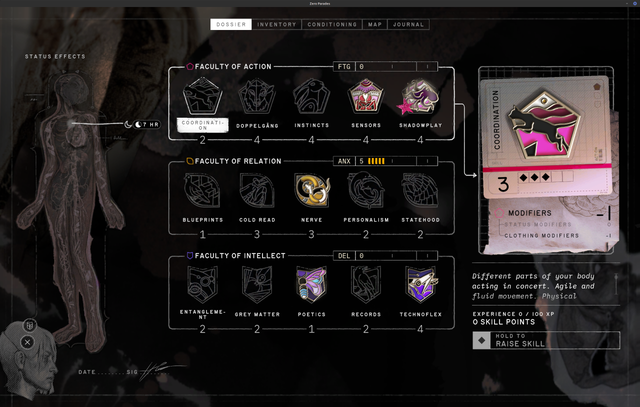
Hershel needs to watch out for her fatigue, anxiety and delirium. Pushing a roll will increase one of these, regardless of whether you pass or fail. Failing a roll, pushed or otherwise, will generally increase one of these detrimental states of body and mind. Hershel can balance out these stats by taking copious amounts of booze, caffeine, nicotine or any number of other drugs. Most will decrease these meters and slightly raise another, so there's a balancing act to think about.
The thought cabinet from Disco Elysium makes a return, only it's called 'conditioning'. You can pick up a thought that gives you some advantages, but they come at a cost. There will be a condition, which - if violated - will cause a detrimental effect for a few in-game hours. Each condition comes with a cool little video piece to explain the thought or idea. Mostly, they seem to increase the level of your skills, but some allow you to do a few sneaky actions, like stealing from vending machines.
The final addition to the gameplay are the dramatic scenes. This is where you'll be asked to make a check outside a dialogue you've initiated. It was touted as a major addition to the game, but it plays out just like any other check, or series of checks. It does build a little tension here and there, but mechanically, it's not so different from any other skill check in the game.
Of the fifteen skills, Doppelgäng and Statehood were my favourites. The former is somewhat crass but funny, whereas the latter talks IN ALL CAPS AT ALL TIMES, and pretty much says everything is BOURGEOIS. In our game, the Statehood skill was quite high, so every other interaction involved us being informed about the ills of capitalism. Quite timely I suppose.
Zero Parades lets you change your clothing throughout the game, with different clothes giving different bonuses or negatives. This is pretty much the same as Disco Elysium. I never really thought too much of this system. Sure, I don't need to imagine how putting on different clothes can make you feel different, but not to the extent that it does in these games - literally making you smarter for example. In a spy game, I could imagine the right clothes being quite important, but the game doesn't really reflect that.
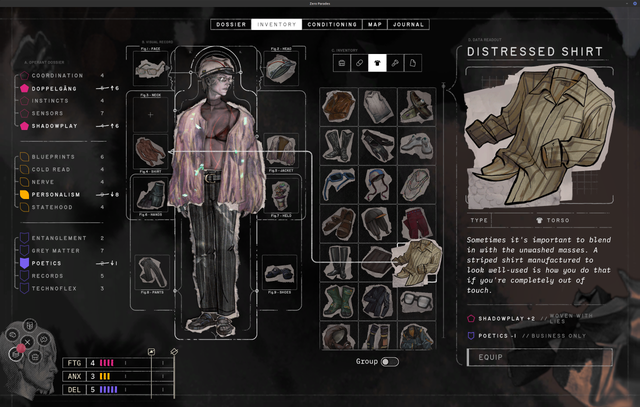
About halfway through the game I picked up a cleaner's uniform that looks like a spacesuit - covers your face head-to-toe. "Excellent" I thought. "That rich chap is getting his flat cleaned. I can put this on and sneak in later". Unfortunately, the game didn't let me act on this very spy-shit idea I had. I was a bit upset about that, but that's the thing with Zero Parades (and Disco Elysium). There isn't a 'stealth mechanic' in this game. Such an addition would be quite a big thing to add and would change the mood a bit too I suspect. But I do wonder if there was an opportunity missed here?
The developers of the game have acknowledged that John le Carré was an influence on the writing2. This was a major plus point for me, as I quite enjoyed Tinker, Tailor, Soldier, Spy and The Night Manager. As a boy, I was quite the fan of James Bond, but as I grew up my taste in spy fiction changed a fair bit. The murky world of spying - full of dubious morals, double-crosses and plans-within-plans.
A number of reviews have suggested that the writing is a little slow in the early game. I think I'd only partially agree. After your main mission has been revealed, the pacing did seem to slow a little. Nevertheless, the writing is top-notch. Some of the characters are quite well realised, though I found myself wondering about our main character Hershel. I haven't decided exactly what her motivations are? Is she super communist, an opportunist, a rock star? I felt the game never really gave me as many options to roleplay out these scenarios. Perhaps that's the point - spies don't have their own personalities any-more. Living in a world of lies probably does that to a person. Still, I never felt like I was taking on a persona at any stage in the game. I was just your average free-wheeling, chaotic neutral, RPG protagonist.
One thing I noticed were the number of gay characters in the game. Hershel herself is listed as having 'possible lesbian tendencies' in her Opera dossier, which you can choose to confirm. One of the major plots in the game involves a gay power couple, a second plot involves a lady getting involved with Hershel (trying not to spoil). At the time, it seemed that this scene in question might have been written by a man, for men. Eitherway, the sexuality of the characters in the game generally, didn't seem to me to be there to titillate or tick a box. Attraction is somewhat painted as another weapon in the spy life, though I was never quite sure, if certain characters genuinely cared for their partners, used them or both. Perhaps that's just a more mature form of sexuality-in-games than we're used to?
In Disco Elysium, ZAUM took aim at all the things. Racism, imperialism, colonialism, capitalism, socialism, communism - take your pick! They were all up for grabs. Zero Parades isn't quite the exploration of politics that Disco is, but one thing it does tackle is Culture, specifically Culture Wars. With it's 90s alternative future setting - with slightly different physics - culture can really be a weapon. Much of the game focuses around a famous pop star and her music, and a mysterious red-disc with her latest track on it.
Zero Parades seems to rely on a fair bit more Woo than I'd normally like. Large elements of the plot, and some of the gameplay mechanics, rely on the acceptance of psychic phenomena, the separation of body and mind, and quasi-religious metaphysics. In some cases, the beliefs of certain characters are quite touching. In others, you'd be forgiven for believing the person is a cultist, in need of mental health support, or locking up for their (and our) own good. One character in particular embodies these characteristics more than others - I won't mention who, but it's pretty obvious when you play the game. But they are not alone - there are several such characters that trend from believers in an odd religion, to folks who appear to have genuine superpowers thanks to unexplained magic.
Info: This next paragraph might spoil the mid-game plot.
Much of the plot hinges around a device that can 'copy' one individual's mind over the mind of another person. It's quite far-fetched and goes against pretty much all the current scientific evidence. Dualism, as far as I can tell, is pretty much made up. It's become quite the thing in science fiction circles - indeed a great many episodes of Black Mirror rely on this conceit for the horror. Increasingly, this dualist view seems increasingly out-of-step with current science. I think this is a misstep in Zero Parade's fiction - the plot could have worked without it.
Info: Spoiler over.
Whether this ruins the game for you or not is down to personal taste I suppose, but I do think it's fair to say that it's the weakest part of the plot, especially when it's played straight in various parts. A fantastical plot detracts from the serious, and down-right morally difficult nature of spy work. I think the plot could have worked quite well without it - there is enough at stake without resorting to woo. Despite these misgivings - which occurred roughly during the middle of the game - I managed to hold my nose and enjoy the spy plot that unfolds.
The art in Zero Parades is absolutely gorgeous! The game world appears painted, just as Disco Elysium did. Your mission progress is recorded on a set of cards that remind me of a tarot deck; beautifully realised in a modernist, punk style (I'm no art critic - I don't quite have the words). They are quite evocative, conveying thoughts and moods related to the task at hand, that words could not convey.
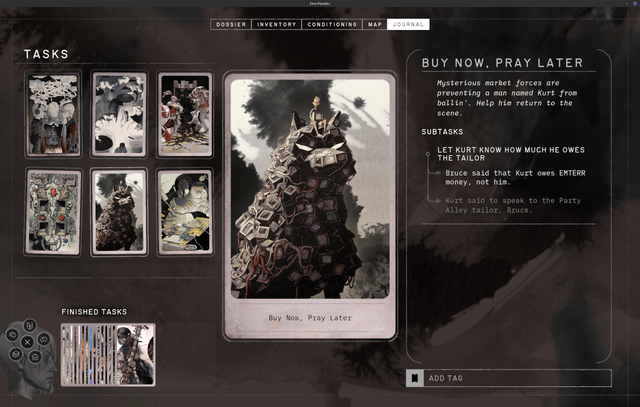
I enjoyed the character portraits, the badges for each of the skills and the art surrounding the 'conditioning' effects you might have. They are all gorgeous to look at. I wish there was a book available with some high resolution prints. I did get hold of the art book, but I wasn't that impressed with it. I'll have to track down the artists themselves and see what they have to offer.
The only thing that puzzles me are the characters' feet - they are all super tiny! I suspect this is a function of the game's perspective, but it still looks wrong to my eyes. It's a minor thing, but once you've seen it, you can't really un-see it.
The voice acting is really rather good, but if you find female vocal fry irritating, you really won't like Boo Miller's performance as the narrator. I thought it was a nice change. Indeed, some of the voices are quite memorable (but more on that later!).
Of all the games I've played, Zero Parades scores the highest for the number of times I shouted at the screen - "Shut up game! You don't know me!". I heard or read someone describe this game as a fourty year old-em up and - while I hate to admit it - it's a pretty good description. I suppose Hershel is a bit younger - in her 30s - but I reckon a good number of the audience are older.
Here's an example of what I mean. One character talks - at length - about their miniature painting hobby. You can have a whole discussion about the correct choice of colour to prime your models. This is incredibly niche, but if you move in these circles - and I do - it's a very deep cut. I wondered, were the writers teasing their audience? Probably not, as it absolutely fits the character in question. Actually, it could be both - mocking and world-building. It felt believable that this character would have such a hobby, given their other pursuits. I think it's one of the strongest parts of the writing.
Another character you meet is an older engineer, working on the phone lines. He seems a bit upset about life in general, but admits he finds pleasure in his 'magnet collection'. I too, have a magnet collection! This has become a running joke in our household now. Such moments in the game made up for the Woo I mentioned, at least in my mind.
If I and other fourty year olds are being teased, it is at least, a gentle teasing. It did make me laugh out loud a few times and helped endear the game to me.
Despite what I said at the top of the post, I - like everyone else - cannot resist the comparison to Disco Elysium. Much like the Doom Clone Phenomena3, a number of games were released (or planned) with the Disco Elysium formula as inspiration. Disco Elysium has been described as a 'lightning in a bottle' moment - a new idea in the over-crowded, oft repetitive computer gaming world. Following up such a game would be tricky for anyone, even the original developers.
So which is best?
Sure, like everyone else I'll have to say Disco Elysium. The protagonist, story and tone are different and there will be folks who prefer the spy shenanigans over the police procedural. However, think Disco Elysium has slightly tighter writing, characters that are a bit more memorable and fleshed out. The skills are better written too, with more interesting dialogue from each one. I feel that Disco has a lot more pathos, as well as more whacky free-wheeling. The world building feels deeper and richer- but then of course it would be, given the original developers had been playing a tabletop RPG in this world for many years.
The different archetypes you can play as in Disco Elysium feel more intense than these of Zero Parades, though I've yet to get through my second ZP play-through completely. In Disco Elysium, I really felt the different between the socialable, charming police officer and the mentally intense, Sherlock Holmes archetype. I'm not sure I can say the same of the different Hershels. Indeed, I'm still not quite sure about Hershel at all. Is this because she's been a spy for so long, she no longer has a personality of her own? Is she really a believer in communism or is it just a job for her? I still don't really know. For my part, empathising with Harry in Disco was a little easier.
The game mechanics are a little more involved in Zero Parades - I like that but I know of others who just prefer the simpler systems, in order to focus on the story. The dramatic scenes could have been great, but there aren't enough of them, and they don't really seem that dramatic after the first. You can take your time choosing - you can even pick a third option to get a little insight into which choice might be best. In the end, it's the same as a red skill check you have to take. I this mechanic was definitely necessary to convey these tense scenes you get in spy drama, but maybe it needed more time in the oven?
I think I prefer the music in Disco Elysium too. British Sea Power came up with the soundtrack for Disco - I've listened to it a number of times. That said, Zero Parades has an excellent end credits piece, that I've listened to over and over. I wont spoil, but I felt it really fitted the ending. The visual art is different between the two - I like both, though the mission tracking card art in Zero Parades is very good.
Finally, Disco Elysium is more scouse4. While there is a scouse accented character in Zero Parades, the character is not in the same league as the famous Cuno from Disco Elysium. In fact, while I'm here I am quite disappointed that Cuno was toned down in the director's cut. In the original game, the accent is even stronger. Cowards I say!
The developers of Zero Parades did have a massive mountain to climb - forever in the shadow of Disco Elysium; it must have been quite the weight on the shoulders of the team. That's a pity as I think Zero Parades really can stand on its own two feet. It brings enough new stuff to the table, without complicating things just to be different (I'm looking at you, Darkest Dungeon 2).
The metacritic reviews are quite telling. The critics love it, the public are much more mixed. The negative views seem to be along the lines of "it's not as good as Disco Elysium" or "ZAUM just copied their previous game". I think that's a bit unfair, but then the fans were deeply disappointed by what happened with ZAUM the company.
While both games are made by ZAUM, it's not really the same bunch of people on both games. Many of the original team were either booted out, or left of their own accord after Disco Elysium was released.
ZAUM came under quite a lot of fire from the fanbase during the promotion, leading up the release. ZAUM's twitter feed was filled with vitriol every time they made a statement. I won't go into it here - suffice it to say that People Make Games covered the breakup of the original team in depth, on their YouTube channel. My conclusion? It's a bloody mess!
It's a shame too, because Zero Parades is a really good game. It's well written, the art is gorgeous and I had a good time with it. I'm not sure the company deserved the negative comments gamers heaped upon them. I suspect the developers and artists just wanted to make the best game they could. Unfortunately, the current ZAUM laid off many of their staff saying "commercial performance has not enabled us to sustain a studio of our current size.".
I suspect the next RPG of this kind - high calibre writing, high art and shades of grey morality - won't be made by ZAUM. The earth they stand on has been salted a little too much for most gamers I expect.
Some folks don't really care about game genres or what not. Others get quite defensive about it. Yet others find it interesting to speculate. I'd seen a blog post asking whether folks thought Disco Elysium was an adventure game or an RPG. At first, I thought 'of course it's an RPG' but after a little more time, I'm not as sure. The chap Chester Bollingbrook - he of the CRPG Addict website - has a fairly long description of what he believes an RPG to be; he has played an awful lot of them, although he did state his terms before starting his epic quest. Nevertheless, he describes the factors that most RPGs have - player progression, combat, an economy of sorts, etc. But I don't think he gets to the real heart of the matter. I think an RPG (tabletop or otherwise) presents a story problem that you get to solve by picking a particular route with a particular character. In a CRPG world, I think it's best exemplified by Fallout 1 and 2. One of the design principles of these games was that every problem could be solved by either stealth, violence or charisma - often a combination of these approaches. This was enough to make a world that felt like you had agency. You could choose the approach and the game would facilitate that.
Many RPGs feature combat. Indeed, it seems only recently that I've seen RPGs with no combat at all. Combat and violence has always been easier to gamify than other sorts of human interactions. The Youtuber Game Maker's Toolkit has an excellent video on why can't conversation be as fun as combat. Now things have moved on since he put that video out, but when an RPG doesn't have combat in it, folks begin to ask - 'is this really an RPG?'. Certainly, I've seen comments to this effect about Disco Elysium, but I've never felt that combat really was necessary. I think a sense of agency is what is necessary. Simulations have this sort of feel. When you can interact with the various systems to bring about your plan, the game comes alive.
Adventure games tend to tell a set story, you just have to find where the next step on the path is. A good RPG is a story you get to tell, at least in part. In this sense, does Zero Parades qualify?
Info: This next paragraph might spoil the ending. I won't reveal the ending but an aspect of it.
The game's ending is mostly fixed. Not to spoil it too much but there seems to really be only two endings - three if you count the occasional, accidental deaths (I got crushed to death by a coffee machine at one point). There isn't that much variation, certainly no ending slides. One of the tag-lines I've seen to describe Zero Parades is "failing is fun". I get the impression that even if you are a crap spy, the ending would play out mostly the same. Some would say that's spy life - it's all out of your control and that was what we wanted you to feel - a helplessness in the face of the bigger picture. It's all about how you get to the end, and the friends we lost along the way.
Info: Minor spoiler over.
So, with no simulation aspects, limited gameplay systems and actions that have little effect on the outcome, can I really say Zero Parades is an RPG?
I'd say Zero Parades (and Disco Elysium for that matter) really seem to inhabit a middle ground between the two genres. This feels like a cop-out, but I think it's the most accurate description. I suppose falling where it does is a characteristic of break-out titles generally - defying easy categorisation. Eitherway, you do get the sense of acting out a particular role, be it a policeman or spy. Both have side-quests that you don't need to complete to get to the end, but they absolutely do sell you on the role you are playing. It's definitely all about the journey and not the destination.
Both games would not do well as a table top RPG (although ZAUM did release a free TTRPG version of Zero Parades). The reason being is that the mechanics are not really there I'd say. Both Hershel and Harry seem to be recovering to their normal hyper-effective selves. Both games limit the maximum skills you can obtain. Harry starts off drinking himself almost to death and has to remember everything. Hershel has been off her game for 5 years, ever since her last failed operation, and needs to sharpen up. Once they've achieved their real selves, most skills are cakewalk for your particular archetype. Sure, you can accumulate a lot of stress in Parades and drop a skill point, but this feels quite rare and a little too simple. It's not like Darkest Dungeon, where characters can develop phobias or negative traits.
I felt that Zero Parades was an excellent game. Though I think Disco Elysium was better, Zero Parades is telling a different story, and I'm grateful for that. I'm having a second play-through, which is rare for me when it comes to RPGs. I do wonder what would happen to Hershel after the end of the game - what the effects of her mission might be on the world at large? Generally, if a piece of media makes me wonder at other possible plots around the edges, it's done it's job well. Now I know how the game is played, mechanically, I'm keen to see how a super-serious communist spy does against the Weeping Eye!
There are a number of games that have either come out or are in the works, based on the model Disco Elysium defined. Esoteric Ebb is one, though it's really not for me (and its combat is a poor fit for the format I'm told). Tangerine Arctic and Hopetown might be more along the lines Zero Parades but these have yet to be released.
As a result of playing Zero Parades, I've gotten back into Spy Fiction. That's certainly a plus point in my book! Complex plots, interesting characters and the fate of the free world in the balance!
Zero Parades is definitely worth picking up and playing if you liked Disco Elysium. It's just not the break-out mega hit, heroic passion project that it's predecessor was, but don't let that get in the way.
Yes, I know it's not true isometric, but that's the name we've all sort of settled on. ↩
Among other big name authors - https://www.thestar.com.my/tech/tech-news/2026/06/22/this-spy-masterpiece-staked-out-le-carr-and-pynchon ↩
Doom was such a mega hit, several games were released soon after, that were very similar. The term 'Doom Clone' was coined, though it would be replaced later with 'First Person Shooter". ↩
Scouse - pertaining to Liverpool. Scouse is a type of stew and an accent common to these from Liverpool and Merseyside. A Scouser is a person from Merseyside. ↩