.:about:.
kurt weiske's retro tech enthusiast, photgrapher, and systems guy. blogging like it's 1999. static blog generation, talking tech...
.:subscribe:.
subscribe to a syndicated RSS feed.
.:links:.
realitycheckBBS
kataan.org
other blog.
.:contact:.
mastodon
tilde.club


Dialed In
I went to a presentation at the Computer
History Museum called Dialed-in: The Prehistory of Social Media.
The event was a discussion with Kevin Driscoll, author of "The Modem world: a Prehistory of Social Media", and danah boyd, author of "It's Complicated".
The event talked a bit about the history of BBSes and contrasted current social networks with the local communities that sprouted up around BBSing.
To me, in a nutshell, BBSing was an exclusive group - not many people had computers, and the onus was on a caller or sysop to buy a modem, get a phone line (or share a line and risk the hazards of doing so...), find terminal software and build a BBS list.
The panel could have been an open discussion - I'm sure many of the people in the crowd were sysops at one time, or even current sysops. Thankfully, they dodged a bullet by avoiding the sys-op/sise-op wars of the 1990s.
I went with 3 sysops/friends of mine from the golden-age of BBSing. Taipan Enigma and Dr. Strangelove started NIRVANAnet(tm), and Zardoz and I were some of the first sysops to join the nascent network. We joked that the panelists missed out on the culture that they were observing.
It was good seeing people I'd spent the 90s conversing with, both online and in person at the user meetups we'd arrange. The idea of going out for beers afterwards was suggested, but I had an hour drive, early work days ahead, babysitters to let go, and so on. Quite unlike the old days when a couple of nights out ended up with staying up all night, posting on BBSes, greasy-spoon diner breakfasts, and going home to nurse a hangover.
posted Fri, 26 Apr 2024
permanent link
Taking a break
I'm taking a one month break from Twitter, Facebook and Reddit. I'm going to
stick with Mastadon for the time being, as it seems unadulterated by
algorithms and company marketing teams - it's just interesting people at
this point.
Reddit, I may browse -- there are a couple of interesting subreddits I read for technical info and advice. We'll see.
I need to find an RSS feed for news, I realized that I get most of my news from Twitter these days.
posted Tue, 16 Apr 2024
permanent link
25 Years!
I realized that my blog and domain (kataan.org) are 25 years old today!
I started a project to move the older items from a text archive
(downloaded from blogger, remember them?) into my Wordpress database.
I hadn't realized that with blogger, I used it like Twitter as a
microblog - there are some days where I posted multiple times a day, on
different trains of thought.
1999 was a crazy, interesting time.
 I was working in the middle of the first dot-com
boom, right in the center of it all. I quit my job at a gaming company
for a jump in responsibility and a share of a streaming music startup
right in the middle of the Napster mess. I was in the meeting on
business deals where we danced around money, because no one was sure who
should be paying whom. Do we pay for exposure, or do they pay for
content?
I was working in the middle of the first dot-com
boom, right in the center of it all. I quit my job at a gaming company
for a jump in responsibility and a share of a streaming music startup
right in the middle of the Napster mess. I was in the meeting on
business deals where we danced around money, because no one was sure who
should be paying whom. Do we pay for exposure, or do they pay for
content?
There were 3 search engine companies within a couple of blocks of me. Hotwired became the cool new site. Friends at web companies were charging clients like they were attorneys, getting them a presence on that web thing that they didn't understand.
South Park, a little green oasis in the SOMA area of San Francisco became the center of "Multimedia Gulch". Companies that had been focused on CD multimedia moved to web design and creative services.
It all went a little too far. fuckedcompany.com documented some of the excesses, like flake.com, a portal for breakfast cereal lovers, and a company down the street that had their coming out party on a Tuesday and closed the doors on a Thursday.
[oh, the parties - it seemed like someone was getting a round of funding and throwing a party in their converted warehouse/sweatshop space. One of the guys at my startup hosted an email list with all of the "private" parties going on almost nightly in SOMA. The recyclers in the area had a field day with collecting empty beer cans and bottles...]
By mid 2001, the money had started drying up, Aeron chairs and office furniture were available at bargain prices from closed-door dot-coms. 9/11 ended the boom once and for all.
A friend of mine, a San Francisco native, went through his address list in 2002 and realized that two thirds of his contacts had left the city as quickly as they'd come a few years back.
But, it was a good time while it lasted.
posted Mon, 15 Apr 2024
permanent link
oldblog
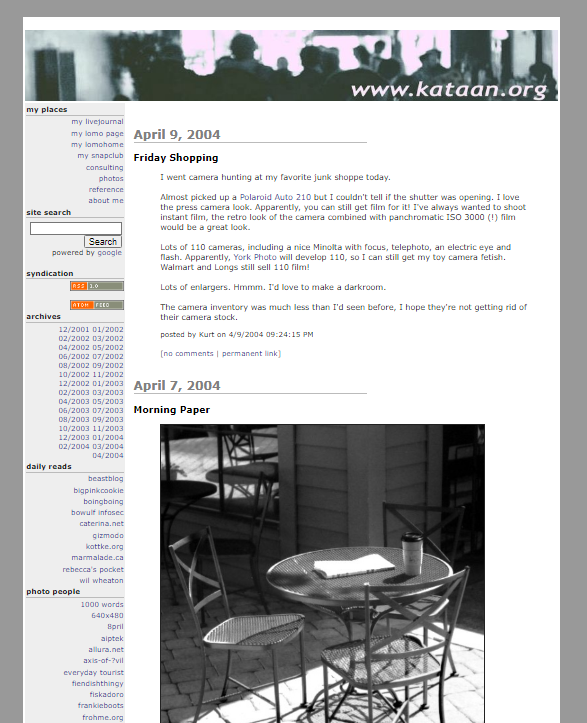
Looking at how this blog is shaping up, it reminds me of my first iteration
of a blog, back when I was consulting and shooting way too much film.
20 years ago, a kind of daily journal of things I found significant, trivial goings-on, photos I'd shot while working in San Francisco and things I wanted to save in Google's cache lest they dissapear.
Man, that was a long time ago - a whole life ago. Most of the photos are of places that no longer exist, old architecture replaced with new.
posted Thu, 11 Apr 2024
permanent link
Smol Protocols
I like the idea of supporting alternative
"smol web"
protocols.
While part
of me likes sticking with low-tech HTML (minimal use of CSS, no scripts,
static content), someone on the BBS brought up an interesting point - you
still need to use a modern browser for security's sake, and that opens up
all sorts of privacy issues - not to mention they're overkill for rendering
basic HTML.
I'd love to find a lightweight, supported browser that didn't support any of the bloat that's been added over the years.
Gemini is nice, the markup is simple, but someone complained that it's SSL only. I don't see that as much of an issue, I prefer encrypting everything to make the target data pool larger. Encrypt your shopping list.
That leaves us with Gopher. The markup is a little more difficult, although it would come back to me after decades. It's not encrypted, not a big deal given the content (although, see my previous comment...). When Mozilla took gopher support out of Firefox, I thought that would be the end of it, but I found a Gopher client for Windows - and now I found Lagrange, a cross-platform browser that does Gopher and Gemini, I'm quite happy.
If only it would support basic HTML, I'd have a perfect SMOL WEB browser...
posted Thu, 11 Apr 2024
permanent link
Write Once, Never Edit
One thing I've realized with blosxom - posts are displayed based on their
modified date, not their created date. So, if I find a typo and correct it,
the post goes to the top of the display. Looking at man (1) touch, I can
pass a date string to the command and reset the modified date, but that
seems overly complicated.
Better to leave posts as-is, errors and all. This isn't meant to be polished, by any means.
posted Tue, 16 Jan 2024
permanent link
Nostalgia
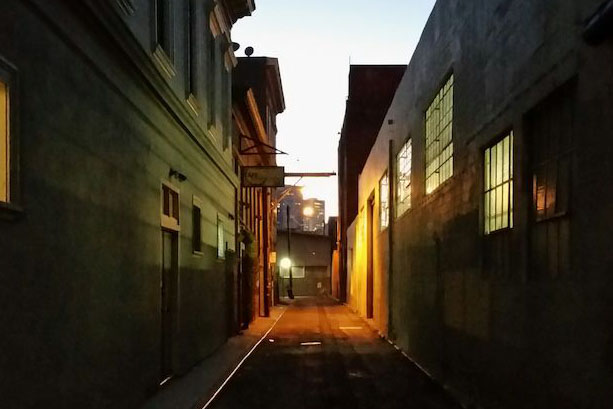
I found my old Flickr account from the 2000s with 18 pages worth of photos.
Going back through them was a nostalgia trip - I shot a lot
of film in the early 2000s, I'd discovered lomography and was working in a
subject-rich
environment, San Francisco. It was a town going through a lot of change, and
some of the buildings I captured were gone in the following weeks and
months.
There's a lot to be said for pocketable cameras. With a LOMO, I'd leave the focus at 8-10 feet and in sunny weather (or shooting with ASA 400 film), you'd probably get your subject in focus. Reach in your pocket, shoot, repeat. I've been shooting again with an old Canon digital pocket camera, but it's not quite the same.
With my phone I need to pull it out, unlock it, press the camera app, wait for it to load, then sight and shoot. It's just not the same.
posted Tue, 16 Jan 2024
permanent link
Internet Nodes...
Reading The Hacker
Crackdown and felt nostalgic at the term "internet node".
Back in the '90s, having an internet presence meant having a box sitting at your employees colocation facility or if you were lucky, on the end of your home DSL connection. I ran Linux as a firewall, web server and mail server on my home connection, others were into the *BSDs, and one friend of mine ran IIS on a DEC Alpha workstation running Windows NT for MIPS processors. I blogged, had a couple of mailing lists, shared secondary DNS for people who offered secondary DNS for me, and ran Jabber for a short time.
I miss those days where you felt like an active participant in the network, rather than a "consumer" of "services" provided by a couple of players.
I've started to see people running their own Mastodon nodes at home or in the cloud, and it's heartening to see people taking control of their presence again.
There are a ton of options nowadays for a home internet node. A Raspberry Pi can suffice. The old PC you have in your closet could do just as well. Some routers can load OpenWRT software, which turns your proprietary router into an embedded linux system that routes, firewalls and can run small apps like static web servers.
I run realitycheckBBS, a telnettable bulletin-board system I'm run since 1991. With my BBS software, I've got traditional telnet and web-based message boards, mailing lists, file areas via FTP, a functional web server with blogging and templates, news server, mail server and IRC. It's all running on a Windows box, but I could easily move it to Linux and get a standalone web server like NGINX or Apache to more easily build non-BBS web apps.
Running this blog is another guily pleasure. I started off with a daily personal blog in 2000. It varied between being a photblog, a personal blog and a place to store techical information I wanted to save. It's now all photos, and another domain hosts a "brand" site with the technical information from the past and new technical info.
I'm running Blosxom, a web blogging tool I remembered from back in the '90s, when PERL was *the* thing - another guilty, nostalgic pleasure.
Stream-of-consciousness blogs fell by the wayside with Twitter and Facebook, it's nice to buck the trend.
posted Tue, 12 Dec 2023
permanent link
Back to Photography
Does anyone miss photography? With an actual camera? I burned through a
*lot* of film in the early 2000s, and complemented film with shooting on
early digicams. I'd say I shot more photos with a camera phone, but those
photos were less creative, less planned, and less thought out.
I miss that sense of combining the surroundings with my vision that cameraphones don't seem to capture.
I have a handful of decent digicams from the mid 2000s, a DSLR that currently has a lens focus issue, and 2 prosumer cameras. I'm planning on taking one with me when I go out. The problem is, I need to look harder for subjects. My best photography days happened when I was working in San Francisco; it's a subject-rich environment, from candid people shots to geometric architecture, street abstracts and urban decay are all within a 30 minute lunch walk.
My photography is available at www.kataan.org if anyone's interested.
posted Thu, 07 Dec 2023
permanent link
How it all started.
I picked up a Casio FX-3600p calculator on eBay recently. 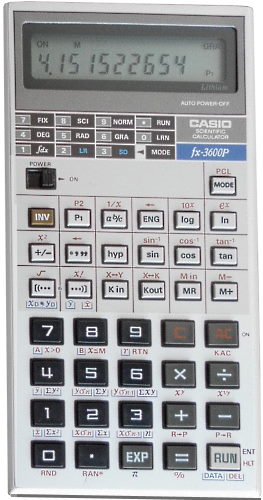
I took a calculus class in college from a professor who inspired me. He'd grown up in a world where people did calculations by hand, and he saw calculators as tools that would free mathmeticians from grunt work and let them do the theoretical work, the dreaming. He required students to spend a little more and get programmable calculators. We spent the semester getting to know our calculators and getting to use them to do all of our heavy lifting, so to speak.
Before that class, I mostly used computers to play games. After that class, I saw calculators and computers as tools to do the repetitive, error-prone work and started programming in earnest.
I was a poor college student, so I picked the Casio - it was the cheapest option available. Other kids splurged on the HP 41CV or HP 71 calculators, which I would have loved to have. I have an HP 41 emulator on my phone, that's the closest I'll come to one.
The FX-3600p is a lightweight compared to today's graphing calculators - it could store two programs in memory and each was limited to (I think) 38 steps. That was enough to store equations and let you run through several iterations to graph it, saving a ton of time.
It does have its charms, though. The calculator I received arrived in great shape, and the original lithium CR2025 battery is still going strong.
posted Thu, 07 Dec 2023
permanent link