 twinbfield

An Altoid tin astrology clock
by twinbfieldPermalink
Inspired by cyberdecks, I created an astrological clock that fits in an Altoid tin.
This year, cyberdecks have become a trend on TikTok. These are minified, custom-built computers, typically running on a single-board computer like a Raspberry Pi and often made from upcycled materials. The trend has been particularly popular among young women, who have been retro-fitting childhood toys to make personalized computers. It's moved beyond niche circles, too, with coverage on the topic by CNN and Newsweek.
Inspired by this trend, I adapted a design for an astrological clock made by nickplaysjazz. I wanted the design to fit into an Altoid tin, and I wanted to power the design by battery. Here, I'll share what I learned about minifying Arduino projects, and what we can learn from this trend.
Overview
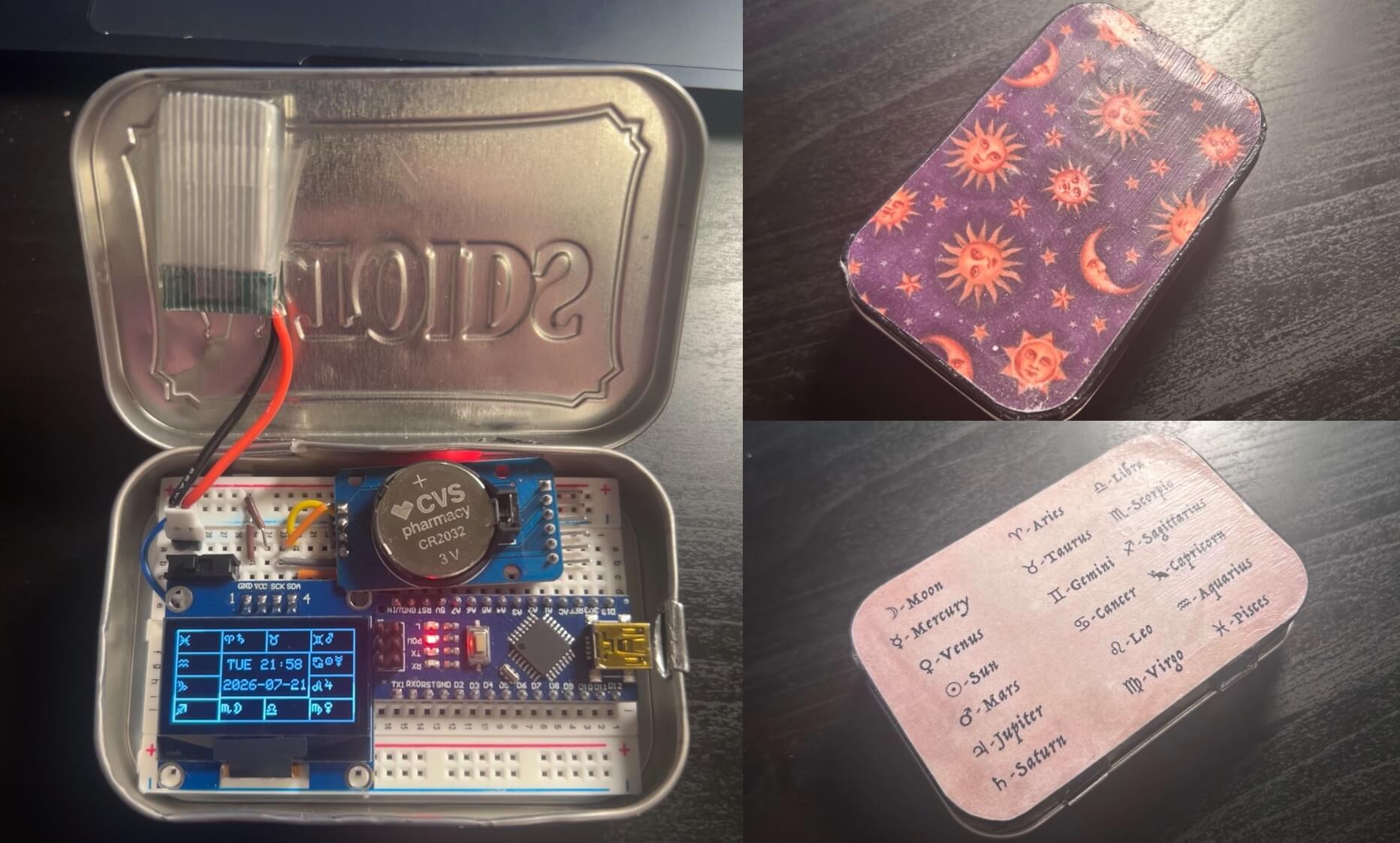
Nickplaysjazz's five-part series does a great job going into the design of the astrology clock. As a brief overview, the Arduino code calculates the position of the planets based on the current time to an impressive accuracy. A real-time clock module with a coin battery keeps the time when the Arduino is not powered. When powered, the LCD display shows the date, time, and the position of the planets in the astrological signs. He provided three different designs. I like the boxes design, as it maximizes the space on the display to show the planet/astrology symbols while maintaining the general layout of a clock.
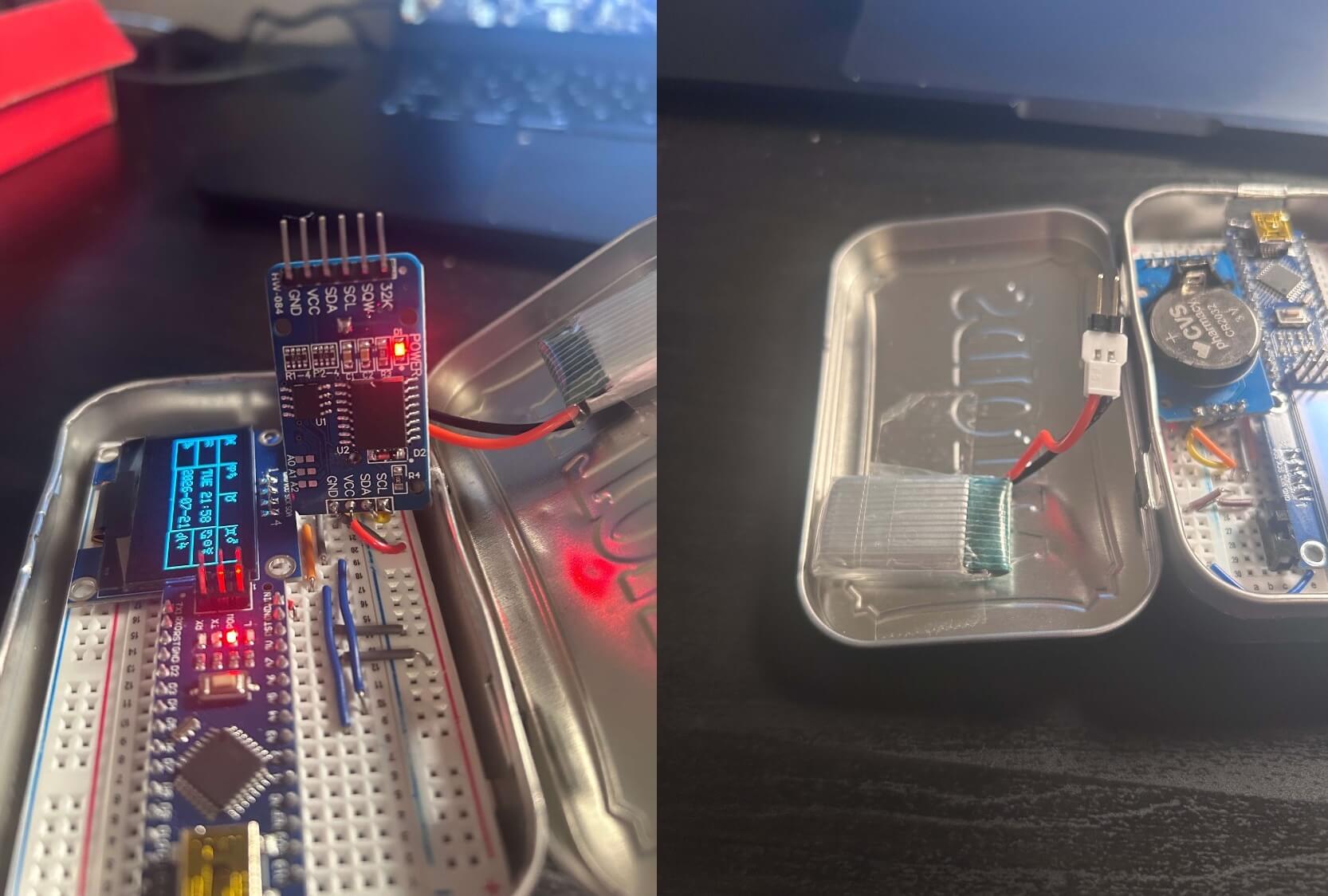
The breadboard that I used just barely fits into the tin. I used a utility knife to cut a hole in the side of the tin for programming the Arduino over USB. The wiring in the tin is dense, and nearly every accessible row is in use. Notably, the real-time clock module came with header pins that sat the module vertically, which would not allow us to shut the lid of the tin. Luckily, there were an alternate set of unsoldered connections for the interface, so I soldered new wires in to allow the module to lie flat. Desoldering the available pins could also have worked.
Powering the design
In my minified design, I included a switch and a 3.7 V lithium polymer battery to power the clock. These batteries are commonly used in drones, and they are fairly inexpensive and rechargeable. A warning: these batteries should be treated with respect. They are easy to short-circuit or puncture if you are not careful, and they can start a nasty fire. The polarity of the battery is also important, as reversing it can damage your Arduino.
There are a dozen different connections for these drone batteries. I bought two different types of connectors that were both wrong before I decided to use two header pins with a plastic spacer instead of a dedicated adaptor. Using a battery with a switch allows us to power the Arduino through the VIN pin instead of connecting a USB, making our project portable.
Decorating the design
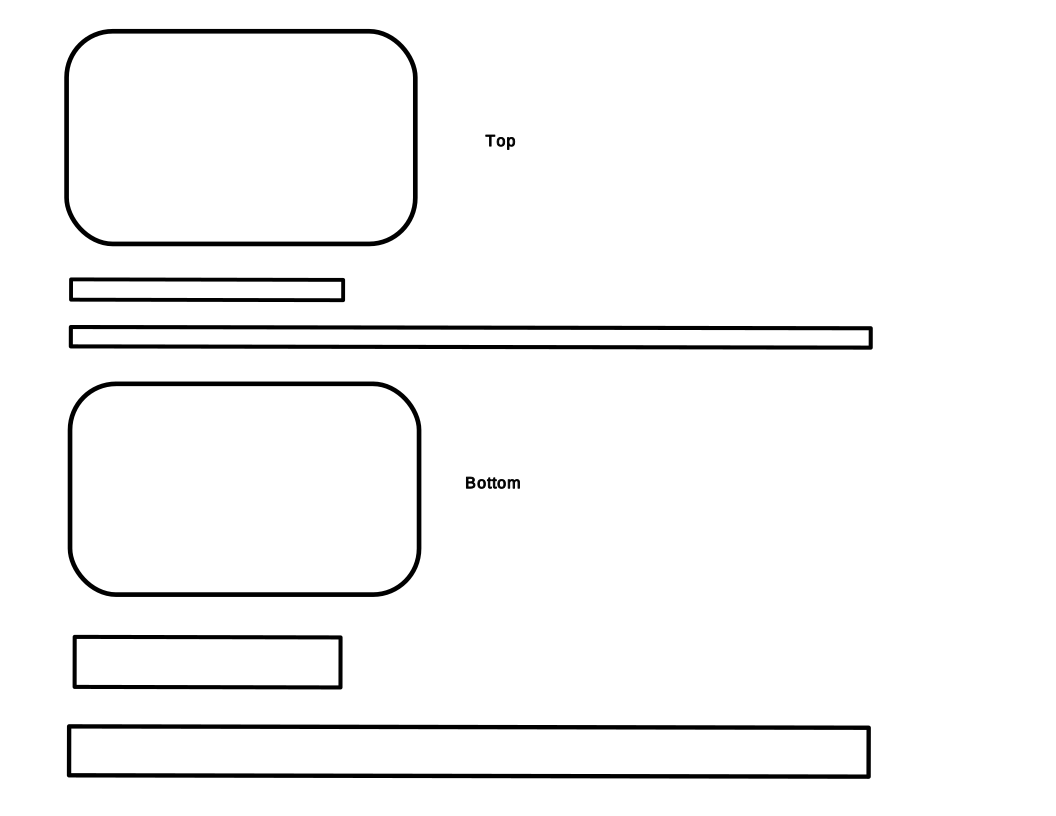
There's a lot of emphasis on personalization and artistry with the cyberdecks I've seen online. An Altoid tin on its own is a bit too utilitarian. To add some flair, I designed a template and printed a vintage star, sun and moon pattern I found online for the top of the tin. For the bottom, I found a parchment pattern where I put keys for all of the astrological symbols. I covered the sides in black washi tape and painted the whole surface with a few coats of Mod Podge to glue everything in place and avoid peeling edges. The Mod Podge is essential here for providing a finished look.
What we can learn from the cyberdeck trend
My Altoid tin astrology clock is a cool display for my desk, but I think there's something more we can learn from the cyberdeck trend. Lately, computing feels so depersonalized and grey. Maybe it's the rise of AI slop and the tech bro hustle. Young people are craving flavor, individuality, and personality. And it's not just the cyberdecks - this craving is mirrored by how personal websites are becoming popular again, and how people are experimenting with more decentralized forms of social media like Bluesky and Mastodon. Here's to more whimsy in computing!