Posts tagged "c":
Scritch your catgirl(1)
Continuing from where we left off in the catgirl devlog, this post covers further fixes and QoL enhancements applied since then.
Reminder: All patches and enhancements mentioned in this post are available on Codeberg and my OBS respository (for deb packages)
Dispelling some (n)curses
catgirl(1) uses ncurses as its toolkit of choice for rendering and implementing its TUI.
Even though it isn't flashy or exciting by today's standards, ncurses (and other curses ports) remains in use due to its portability across operating systems - even Win32/WNT via pdcurses - and its support for a wide variety of terminal emulators via terminfo(5).
As one might expect from a TUI API originally designed in 1978 (!), the (n)curses C interface is quite baroque, requiring one to write a fair amount of boilerplate code to get anything on the terminal: ncurses "windows" have to be invalidated & refreshed by hand, and resizing or reflowing an ncurses TUI must be handled explicitly. Dynamically-sized TUIs in ncurses are built by computing window dimensions relative to extern C variables COLS and LINES, which ncurses updates on SIGWINCH to match the current terminal size.
Naturally, this results in a lot of housekeeping code just to draw the UI, and more code usually means more places for things to go wrong.
Reflowing
Reflowing (or wrapping) in typography is the process of moving words between lines - usually from the line above to the line below - as a result of a typographical change - e.g. adjusting the font size, or, more commonly in text-based TUI applications, changing the dimensions of the output surface.
It turns out that terminal emulators are relatively unconstrained when it comes resizing. KDE's Konsole, for instance, will happily allow the user to shrink a terminal viewport to a miniscule 1x1 or even a pixel-thin 1x0.
Does it make sense to reflow on a 1x0 viewport? Not really, as nothing will be visible either way. However, it does makes sense to make sure we do not break if this does happen (in my case - by accident, while attempting to resize the terminal horizontally in order to wedge it next to an emacs(1) frame).
Resizing
The tiny-terminal edge case also needs to be handled when computing new window extents after a SIGWINCH. ncurses' wresize() does not appreciate being fed values < 1 for its line or column parameters, so some clamping was necessary here.
Overflow Indicators ($)
As per RFC 1459, IRC typically has a line length limit of 512 octets. While many modern servers and clients support longer lines (often advertised via the LINELEN ISUPPORT token), catgirl(1) remains faithful to the original 512-octet limit. It ensures long lines are split into multiple messages at this boundary, visually indicating the split in the input prompt.
The input prompt window (or "pad" in ncurses jargon) has a fixed backing buffer. catgirl(1) allocates its size to 1024, allowing us to edit roughly two messages' worth of text at once at the prompt.
One could work around this by managing the backing buffer manually, but catgirl(1)'s input prompt performs IRC formatting code interpolation. This requires iterating over the entire string before rendering; at a certain point, interpolating massive strings becomes a performance drag. A fixed column size is a fair compromise.
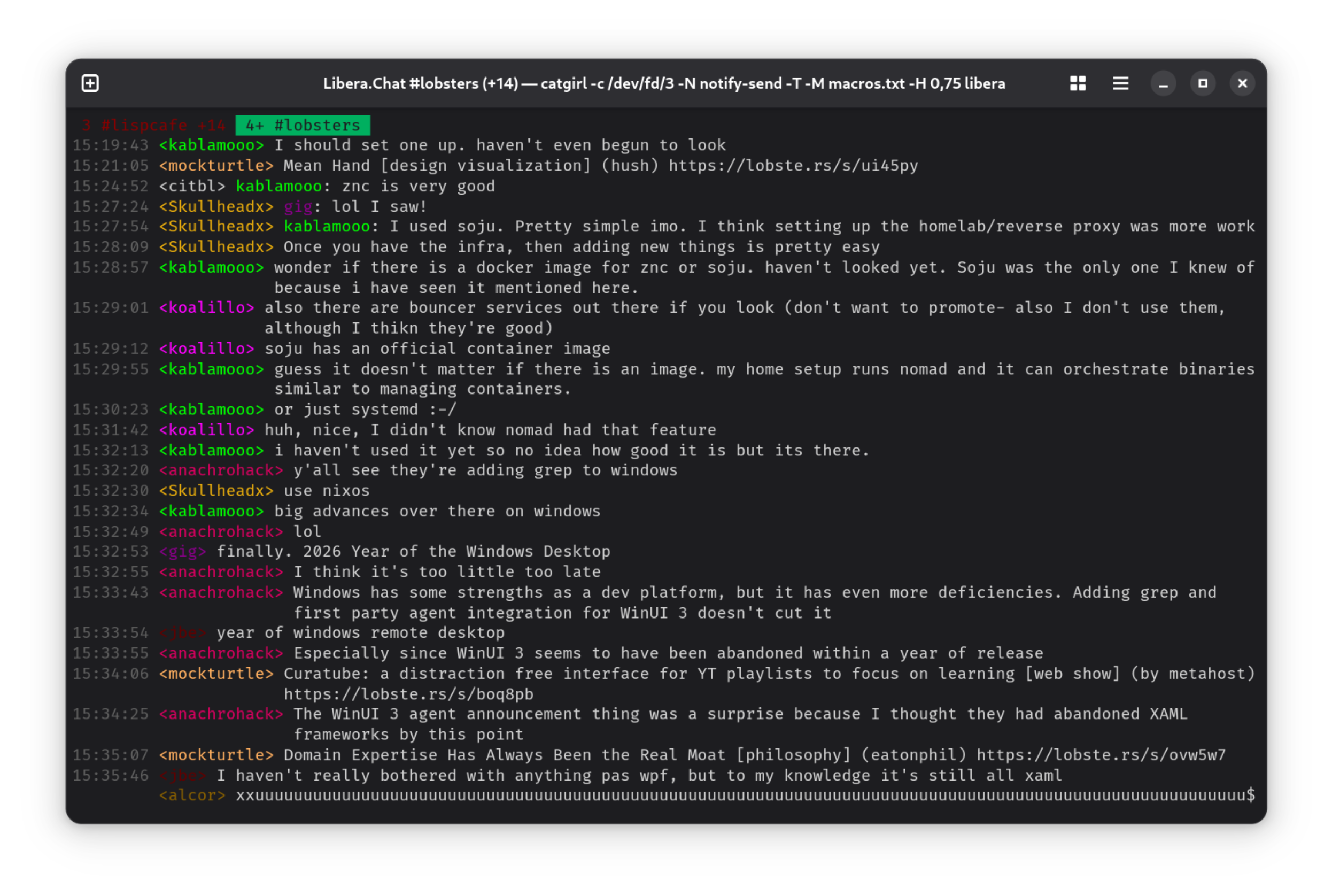
But how do we signal that the input has overflowed the pad's backing buffer? Borrowing a convention from several traditional UNIX programs, I've added a $ indicator. If the EOL is currently off-screen, a $ is rendered at the bottom-right corner of the input prompt.
The logic for this was slightly more involved than expected. We have to track the message's content length against the backing buffer's limit and render the $ in its own 1x1 ncurses window at the viewport's edge.
Securely Passing Secrets
catgirl(1) has excellent support for certificate authentication via SASL or CertFP - you simply pass a filename containing your key.
But what if you want to use a secret manager, or something like systemd-creds(1), to avoid storing secrets in plaintext? (Note: Thanks to CM on RektIRC for suggesting this).
Since catgirl(1) accepts any filename, it can handle pseudo-files like /dev/fd/.... I've been using a wrapper script to securely decrypt and pass certificates for months:
#!/bin/sh
set -e
SECRET=$(mktemp --suffix=.catgirl.cred)
if exec 3<>"$SECRET"; then
    unlink -- "$SECRET"
else
    unlink -- "$SECRET"
    exit 1
fi
systemd-creds --user decrypt "$HOME/.config/catgirl/irc.pem.cred" >&3
exec "${CATGIRL:-catgirl}" -c /dev/fd/3 "$@"
The above sh(1) script:
- Opens a temporary file.
- Associates it with file descriptor 3.
- Unlinks (deletes) the file immediately (it stays on disk only as long as the FD is open).
- Decrypts the secret (the certificate) into that FD.
- Passes the path via
/dev/fd/to the client.
This ensures the plaintext secret never sits on the disk. However, there's a catch: an open(2) on /dev/fd/n is often equivalent to a dup(2), meaning the file object remains open and accessible via /proc/<pid>/fd/3.
While some programs use special notations like fd:<n>, I've opted for a simpler fix, involving detecting pseudo-fd filenames and closing the corresponding FD after use. It doesn't cover every edge case (like symlinks), but it handles the standard workflow decently.
Incidentially, I think this is a good example of "progressive enhancement" in a systems programming context: Making the client accommodate the quirks of the Linux/BSD pseudo-fd filesystem.
Wrapping up and more IRCv3 Stuff
While working on the above patches, I've spent some time prototyping an implementation of IRCv3 replies. Some clients, like Halloy, opt for a traditional, threaded reply display. Due to the complexity of implementing threaded views in an ncurses TUI, and due to some of my own opinions on their compatibility with the "IRC climate" of ephemeral backlogs and fast-paced "FIFO" communication, my implementation is based on color-coding/marking related messages in reply chains:
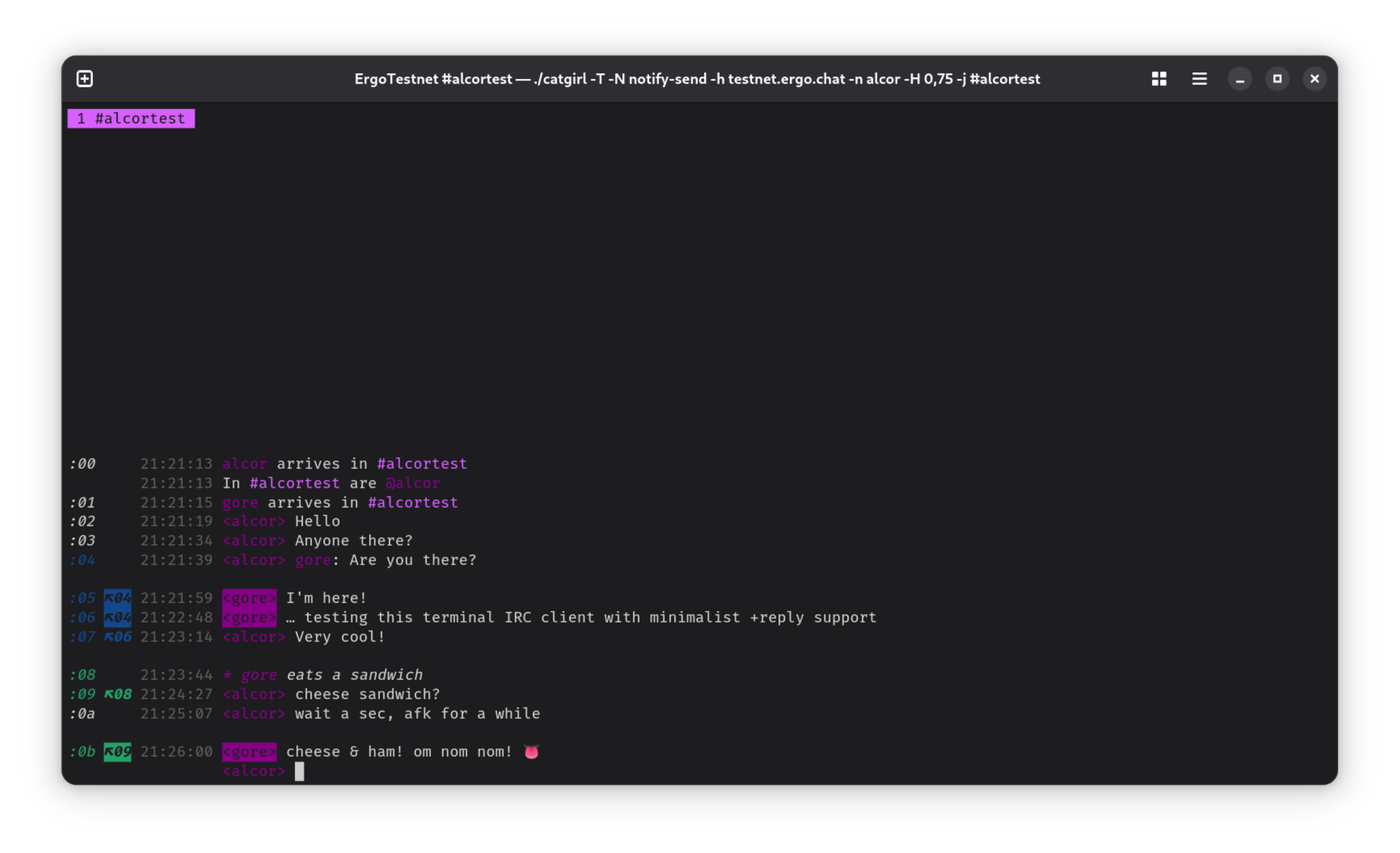
Few networks support the +reply tag yet, so this will be a slow-burn refinement until the extension sees wider adoption.
In the meantime, working on this has made me a bit more ambivalent about certain IRCv3 features. I'll go over these opinions in a future post.
Pimp your catgirl(1)
⣿⡟⠙⠛⠋⠩⠭⣉⡛⢛⠫⠭⠄⠒⠄⠄⠄⠈⠉⠛⢿⣿⣿⣿⣿⣿⣿⣿⣿⣿
⣿⡇⠄⠄⠄⠄⣠⠖⠋⣀⡤⠄⠒⠄⠄⠄⠄⠄⠄⠄⠄⠄⣈⡭⠭⠄⠄⠄⠉⠙
⣿⡇⠄⠄⢀⣞⣡⠴⠚⠁⠄⠄⢀⠠⠄⠄⠄⠄⠄⠄⠄⠉⠄⠄⠄⠄⠄⠄⠄⠄
⣿⡇⠄⡴⠁⡜⣵⢗⢀⠄⢠⡔⠁⠄⠄⠄⠄⠄⠄⠄⠄⠄⠄⠄⠄⠄⠄⠄⠄⠄
⣿⡇⡜⠄⡜⠄⠄⠄⠉⣠⠋⠠⠄⢀⡄⠄⠄⣠⣆⠄⠄⠄⠄⠄⠄⠄⠄⠄⠄⢸
⣿⠸⠄⡼⠄⠄⠄⠄⢰⠁⠄⠄⠄⠈⣀⣠⣬⣭⣛⠄⠁⠄⡄⠄⠄⠄⠄⠄⢀⣿
⣏⠄⢀⠁⠄⠄⠄⠄⠇⢀⣠⣴⣶⣿⣿⣿⣿⣿⣿⡇⠄⠄⡇⠄⠄⠄⠄⢀⣾⣿
⣿⣸⠈⠄⠄⠰⠾⠴⢾⣻⣿⣿⣿⣿⣿⣿⣿⣿⣿⢁⣾⢀⠁⠄⠄⠄⢠⢸⣿⣿
⣿⣿⣆⠄⠆⠄⣦⣶⣦⣌⣿⣿⣿⣿⣷⣋⣀⣈⠙⠛⡛⠌⠄⠄⠄⠄⢸⢸⣿⣿
⣿⣿⣿⠄⠄⠄⣿⣿⣿⣿⣿⣿⣿⣿⣿⣿⣿⣿⣿⠇⠈⠄⠄⠄⠄⠄⠈⢸⣿⣿
⣿⣿⣿⠄⠄⠄⠘⣿⣿⣿⡆⢀⣈⣉⢉⣿⣿⣯⣄⡄⠄⠄⠄⠄⠄⠄⠄⠈⣿⣿
⣿⣿⡟⡜⠄⠄⠄⠄⠙⠿⣿⣧⣽⣍⣾⣿⠿⠛⠁⠄⠄⠄⠄⠄⠄⠄⠄⠃⢿⣿
⣿⡿⠰⠄⠄⠄⠄⠄⠄⠄⠄⠈⠉⠩⠔⠒⠉⠄⠄⠄⠄⠄⠄⠄⠄⠄⠄⠐⠘⣿
⣿⠃⠃⠄⠄⠄⠄⠄⠄⣀⢀⠄⠄⡀⡀⢀⣤⣴⣤⣤⣀⣀⠄⠄⠄⠄⠄⠄⠁⢹
So you want to use (or go back to using) IRC after testing the waters via your favorite website's KiwiIRC or TheLounge webclient. You've lurked in the main chat channel long enough for people to mention "clients". Actual native clients - none of that web stuff.
You scour the web until you find a minimalist terminal client which is 98% of what you want. It's easy to configure. It works. It looks fine in your terminal emulator. You're mostly happy with it - but you have a few things you'd like to fix. You want that last 2%. You want to make it comfy. But it's written in C, and you haven't touched that for a long time - so you hold off on that plan for a while.
Eventually, the missing 2% irks you enough that you decide the time investment is worth it. The quest for a comfy catgirl(1) is the subject of today's devlog.
Note: If you are interested in the finished product, deb packages are provided here
Setting up the git(1) Repository
This will be a "soft fork." I expect to rebase my changes onto upstream periodically, or possibly even push some of them back. Therefore, adding the upstream remote with git remote add ... is a good start.
Ensuring Everything Really Works
catgirl(1) is a C program. I've been using it for months without any crashes or segfaults, so it might be safe to assume that most of the common code paths do not have egregious memory access bugs.
However, one can't be certain unless some form of allocator or memory-access instrumentation is used. Before performing more drastic modifications to the code, it's worth inspecting it for easily-solvable memory bugs.
valgrind(1) is often used for this; it works by hooking into libc's malloc() and free() to catch leaks and use-after-free bugs in heap allocations. However, newer versions of GCC and Clang offer a more broadly effective solution: AddressSanitizer (ASan). ASan instruments all memory access operations, inserting bounds checks for any object access, regardless of whether the memory is stack- or heap-allocated.
Since ASan is included with gcc, adding -g -fsanitize=address to CFLAGS when make(1)-ing the project is all that's needed to produce an instrumented binary.
Does running the program under ASan find anything? Yes! Switching buffers terminates the program, with ASan barfing out a trace complaining about a use-after-free. The trace is straightforward and pinpoints the exact location of the initial free() and the subsequent access. This made for an easy fix.
Adding Custom Macros
catgirl supports simple macro substitution by typing \macro and pressing C-x. While this is fine, there are two issues with this approach:
- catgirl uses a hardcoded macro table (Fine if you're happy with the predefined macro set, but we want more bling 💎✨)
- The backslash is actually an allowed character in IRC nicknames (See the <nick> rule in the RFC1459 pseudo-BNF)
To address #1, I implement a mechanism for loading macros from a simple two-column <macro> <substitution> configuration file.
My initial version of this was overly complicated and attempted to parse the file by hand via character comparisons and iswspace(). While wading through manpages in search of a better solution, I discovered scanf() scansets. Neat! Not only do these functions have support for scanning wide character strings, but they allow encoding some of the scanning constraints within the format string via scansets.
The original code used a linear search for macro table lookups, so I replaced that with a binary search. This is intended to be more of a simplification rather than an optimization - lsearch(3p), although not part of standard C, would've been a possible alternative.
I also added a /macros command to display the macro expansion table and (re)load new macro files. As for #2, I picked a new prefix character to replace / - according to the RFC1459 pseudo-BNF, . is a possible choice - it's not a valid nickname character (as it's reserved for hostnames), so it won't interfere with nick completion.
Fixing Minor Annoyances
While testing the macro implementation, I ran into a couple of minor bugs - sometimes, macros weren't being expanded. This was harder to fix than expected because it seemed to happen sporadically without a clear trigger. Naturally, I assumed the new code was the culprit.
The next time this happened, attaching to the process via gdb(1) and inspecting the line editor's state offered some insight into the cause: Sure enough, there's a subtle off-by-one error in the macro expansion logic. After reproducing this on the upstream sources, After reproducing this on the upstream source, I was able to apply a permanent fix.
Next was an issue with the overflow marker bleeding into the prompt area, caused by a missing color pair (pen) reset when updating the input state.
Finally, I constrained command completion within the network (server) buffer to slash-prefixed entries. This prevents the client from completing "N" to "NickServ" when you're just trying to type a command. It's mostly a correctness fix; in practice, erroneous completions are just rejected as invalid commands.
WALLOPS
During testing, the Libera.Chat admins sent a Wallops. Apparently, a new Linux LPE was discovered and people were talking about it. I didn't get it.
It turns out catgirl(1) didn't support receiving Wallops. Luckily, the message format is simple. An implementation only needs to echo the message to the network buffer. Implementing a /wallops command to send a Wallops is only marginally more difficult due to the similarity to PRIVMSG.
I was too lazy to set up my own ircd for testing this. Luckily, the RektIRC IRCops agreed to send me a couple of Wallops so I can test this. They worked! Nice.
IRCv3 echo-message
Libera.Chat and other IRC networks support the IRCv3 echo-message extension. This echoes sent messages back to the client, which may seem redundant at first until you consider that:
- Many channels transform received messages (e.g., stripping control code via Libera's +c chanmode)
- It serves as a latency measurement
- It acts as an acknowledgment that the server successfully received the message
The spec notes that clients may choose to disable local echoing of sent PRIVMSG and NOTICE messages altogether, so I did just that. While there is a tiny delay between sending a message and the echo appearing, I found it negligible in practice.
Input History
catgirl(1) uses the ↑ and ↓ keys to scroll the window backlog, while PgUp and PgDn scroll pagewise. C-p and C-n cycle buffers, and M-p/M-n scroll to highlighted terms.
Aside from the fact that much of the keybinding "real estate" is used for the scrolling functionality, there is no implementation of readline-like edit history commonly seen in other IRC clients.
I was able to do a fairly compact implementation of this, integrated into the input handling unit, without modifying other code. Finding an appropriate keybind for this required some research. Originally, I wanted to use M-↑ and M-↓ - however, binding to arrow keys within terminals in not portable, so eventually I settled on M-, and M-. with M-↑ and M-↓ as alternate keybindings.
Replacing the Completion Engine
As a side project, I experimented with modifying the completion module to use a Treap data structure. Originally, catgirl(1) used a doubly-linked list, which was simply traversed linearly and searched with str[n]cmp() for implementing tab completion.
While the original implementation is O(n), it’s barely noticeable in daily use. Glibc’s vectorized implementations of strcmp() and memcmp() make linear searches incredibly fast.
I did a few tests comparing the averaged lookup performance of the original O(n) implementation with the O(log n) treap-based implementation for word lists of size 1.000, 10.000, up to 50.000, and the difference between the two was around 1-5ms. In the end, I decided to retain the treap-based code in my branch since it is already tested and working, while acknowledging that it may not be worth incurring the additional complexity (I may decide to remove this later).
Wrapping up
I spent a few days testing, rebasing, and revising the various commits. Throughout the process, I set up an OBS project to build deb packages for the distros I use. I installed resulting artifacts and used the packaged client on a day-to-day basis as a form of dogfooding.
At this point, I felt that the modified client was comfy enough for my usage. Was it worth it? IMO, yes - ultimately, the modifications were fairly compact and compartmentalized, and putting the educational value aside, the client can be now considered "feature complete" from my point of view.
